Reading literacy as a key to democratic capability
Reading literacy is part of the foundation of a vibrant democracy – because only those who understand can participate, question, and shape what comes next.

Our democracies face major challenges
Fake news, social division and political polarisation threaten open dialogue and constructive coexistence. In a world where information spreads quickly but is often consumed only superficially, one fundamental skill is gaining ever more importance: critical thinking. But how do we develop this skill? An often underestimated answer lies in the power of reading literacy.
Reading – in the sense of 'deep reading' – is far more than absorbing information. It strengthens our ability to put ourselves in others' shoes, reflect on different perspectives, and understand complex relationships. These are exactly the skills a functioning democracy needs.
Because anyone willing to enter the thought-world of another can grasp the complexity of a society and develops empathy and respect – two cornerstones of democratic life together.
Stiftung Lesen – German Reading Prize 2025
Reading is much more than a basic skill – it's a superpower!
… a superpower that connects people, opens doors and turns dreams into reality. That's exactly what Stiftung Lesen has been working passionately for since 1988.
Their goal? To unlock the power of reading for everyone – regardless of background or social circumstances. Children, young people and families in disadvantaged conditions especially need support to gain access to stories, knowledge and new perspectives.
With tireless commitment, the foundation works together with institutions, researchers, companies and volunteers to spark a love of reading and improve educational opportunities. Because those who read can understand the world – and actively help shape it.
Alarming numbers – where do we stand today?
- One in three families doesn't read aloud – missed opportunities for children's language development and education.
- Reading literacy in primary school: a quarter of pupils don't reach the minimum standards in reading by Year 4 – a major hurdle for all subsequent learning.
- Books at home are a decisive factor: more than half of eighth-graders without books at home fail to reach minimum reading standards – with serious consequences for their future careers.
- Adults in Germany: more than 6.2 million adults in Germany cannot read.
These numbers are alarming, but they are not unchangeable.
How volunteers strengthen society through reading programmes
The German Reading Prize – a celebration of literacy and creative minds
Every year, the German Reading Prize celebrates people and projects who drive reading literacy in Germany with extraordinary passion. It shows how diverse and inspiring this work can be: from innovative digital approaches to early childhood language development to creative initiatives in schools, libraries and communities.
The nominees prove that reading literacy is the key to social participation and lifelong learning. They build bridges to new worlds – and deserve the highest recognition.
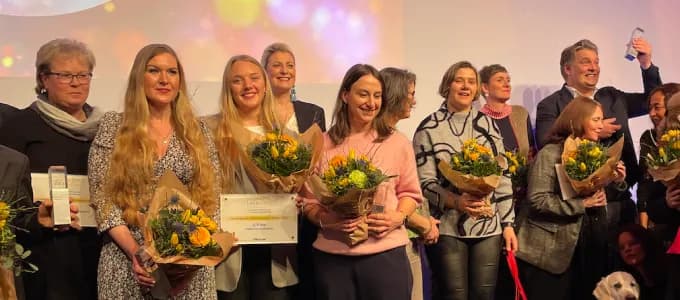
From nearly 400 applications, 50 outstanding projects and individuals were shortlisted across five categories. Fifteen of them were honoured on 18 February 2025 in the festive setting of the Humboldt-Carré in Berlin.
Winners of the German Reading Prize 2025
Category: Outstanding individual engagement
Sponsored by the PwC Foundation
- 1st place: Lale Öztürk – bringing picture books to life with colourful slides
- 2nd place: Helen Daughtrey – "Mädels, die lesen" (Girls Who Read)
- 3rd place: Jean-Dominique Risch – Reading must not be a privilege, books in children's hands
Category: Outstanding community engagement
Sponsored by the German Association of Cities & Deutsche Fernsehlotterie
- 1st place: Nachbarschaftsheim Wuppertal e.V. – The children's reading wagon: literacy on the playground!
- 2nd place: Regional Library Weiden – Regibert total verhext | Weidener Literaturtage 2024
- 3rd place: Johanniter Hilfsgemeinschaft Meerbusch – Johanniter reading dog
Category: Outstanding language and reading development in kindergartens
Sponsored by Fröbel e.V.
- 1st place: Fröbel kindergarten and family centre Finkenberg
- 2nd place: Children and family centre Nauborn
- 3rd place: Kita Evangelische Auferstehungsgemeinde
Category: Outstanding reading literacy in schools
Sponsored by Arnulf Betzold GmbH
- 1st place: 78. Schule – primary school of the City of Leipzig
- 2nd place: Stadtschule Travemünde
- 3rd place: Willy-Brandt-Gesamtschule Bochum
Category: Outstanding reading literacy with digital media
- 1st place: TU Chemnitz – ZLB: LeOn – Leseraum Online
- 2nd place: Hans-Fallada-Schule: Talking Books – a peer project for reading literacy
- 3rd place: Ursel Scheffler: "BÜCHERBRÜCKEN", the multilingual app from "BÜCHERTÜRME"
🏆 Special prize for prominent engagement from the Commerzbank Foundation
Bernhard Hoëcker
Our favourite winner: LeOn
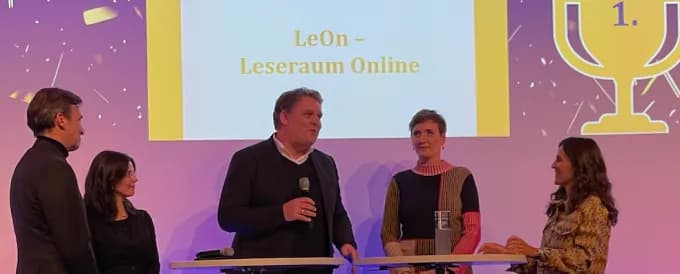
LeOn – "the digital gym for reading"
LeOn is a library that's always where it's needed – not on tall shelves, but on the school computer, the classroom tablet or at home at the desk. A digital reading space, easily accessible and usable anytime: pupils in Years 2 to 6 simply log in with a QR code, get started and dive into their personal reading world.
The House of Reading
So no one loses their bearings in the digital environment, LeOn follows a simple principle: just like in a house, different "rooms" target different reading skills in a focused way – intuitively and playfully. Teachers can support their classes individually, track reading progress and apply targeted interventions.
A gym for reading
With every line read, text comprehension grows, reading speed sharpens and fluency improves. Instead of dumbbells and treadmills, there's a reading library of around 150 texts tailored exactly to the needs of young readers. What makes it special: the texts come in three difficulty levels, so both struggling and confident readers can work with the same content – each at their own pace.
TU Chemnitz & the Ministry of Schools and Education of NRW
TU Chemnitz is responsible for the platform's content and methodology. Under the leadership of Prof. Dr. Michael Krelle, LeOn was developed on the basis of proven reading-didactic methods. So LeOn isn't just a digital tool – it's a scientifically grounded reading programme that emerged from research and is continuously refined.
A success story
The Ministry of Schools and Education of North Rhine-Westphalia makes LeOn available to all schools in NRW completely free of charge via the Bildungsmediathek NRW platform. Over 150,000 pupils use LeOn regularly. A success story showing how modern reading literacy work functions – and perhaps soon not only in NRW, but across all of Germany.

Former CEO of Dussmann KulturKaufhaus & Ullstein Verlage. Co-founder of snackz.ai on a mission to make books more discoverable.